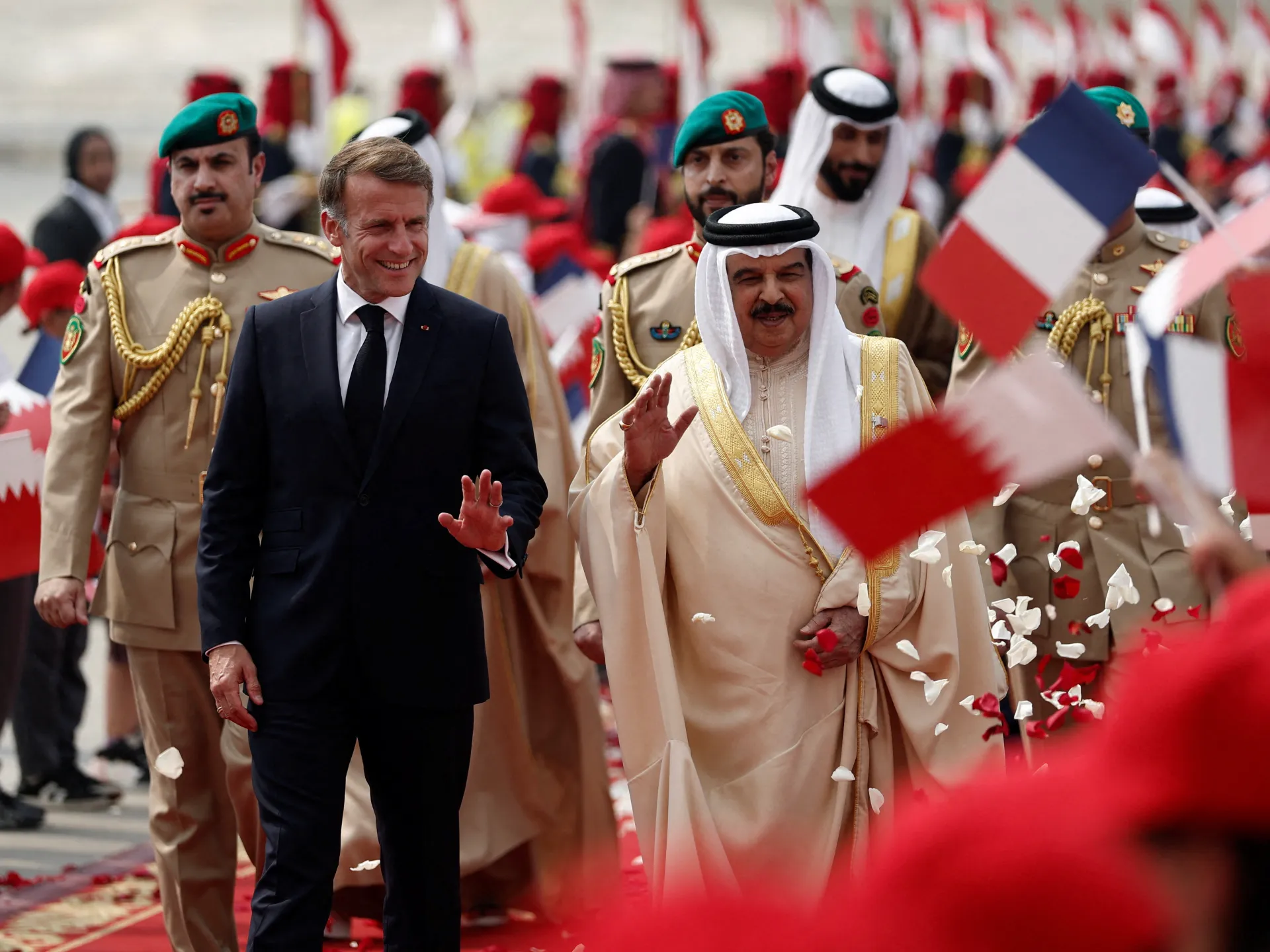
President Emmanuel Macron is touring the Gulf region to secure energy supplies and strengthen defence partnerships as France confronts domestic unrest and energy shortages tied to the Iran conflict.
Macron has visited Kuwait and the United Arab Emirates and is currently in Bahrain, with Qatar next. On his first stop, France and Kuwait signed eight bilateral agreements covering defence, artificial intelligence and investment. In Abu Dhabi, Macron and UAE President Sheikh Mohamed bin Zayed Al Nahyan reaffirmed cooperation in energy and advanced technology. The UAE is France's largest importer in the Gulf, with bilateral trade at 10.8 billion euros in 2025.
The trip addresses urgent domestic pressures. France faces widespread violent protests over a proposed government budget that would cut public spending. More than half a million people protested across France on Saturday demanding better education funding and action on the cost-of-living crisis. Over 2,500 people have been arrested during weeks of demonstrations involving looting and arson. Energy prices have spiked across Europe due to disruptions from the Iran conflict, and up to 20 percent of French petrol stations have run out of fuel at various times since the war began.
Macron arrived accompanied by executives from TotalEnergies and Engie, France's two largest energy groups. His visit has yielded concrete supply commitments. The UAE committed to supplying 100,000 tonnes of diesel monthly to France for an unspecified duration. Bahrain agreed to the same monthly volume, while Saudi Arabia will provide 95,000 tonnes in October and November via TotalEnergies. Oil prices hover above $100 per barrel.
Beyond energy, France aims to boost defence equipment exports to address record national debt, the highest since World War II. Macron announced France would deploy troops and defence systems to Saudi Arabia to protect the Red Sea port of Yanbu, critical for energy transport. Last month he stated "soldiers, radars, defence systems" would be sent to defend Saudi oil facilities against Houthi attacks. French Foreign Minister Jean-Noel Barrot met Saudi counterpart Prince Faisal bin Farhan Al Saud on Monday to review bilateral relations and reaffirm France's solidarity amid regional threats.
According to King's College London security studies lecturer Andreas Krieg, Macron's visit reflects "a much larger geopolitical transformation" in which Europe and Gulf states seek independence from American security decisions that carry "substantial economic and political costs."