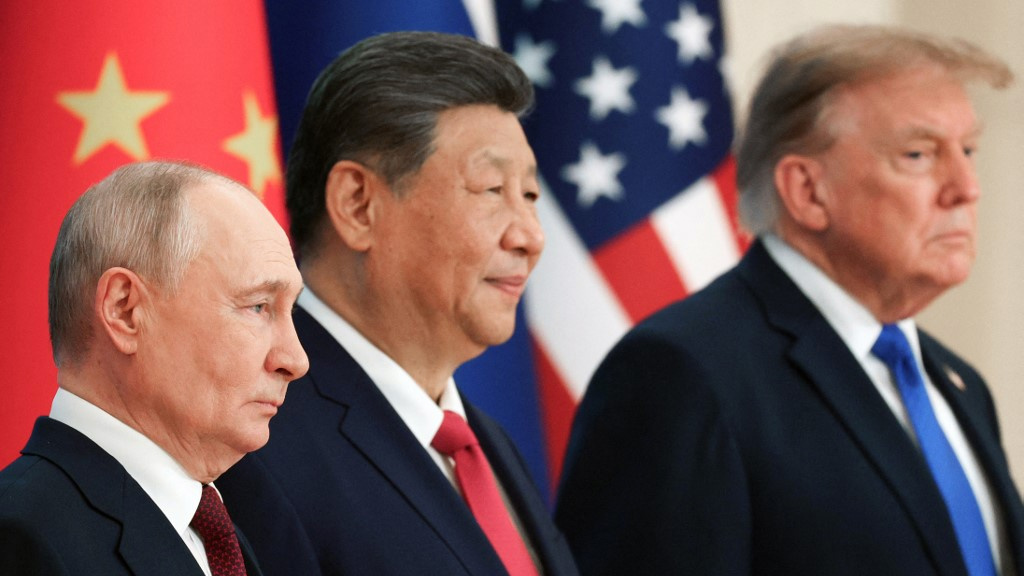
The first trilateral meeting of the leaders of the United States, China and Russia produced a thin four-point declaration and no carve-up of the world. The report is right that the text decides almost nothing. But the format of the meeting, three powers around one table with no Europeans present, is the more important fact, and Europe should treat it as a warning rather than a footnote.
The declaration's contents show how little was agreed. The three leaders committed to reforming the UN, pledged to increase production and supply of refined petroleum products, warned that the International Criminal Court and similar bodies "must not abuse their jurisdiction", and reaffirmed that "a nuclear war cannot be won and must never be fought". Ukraine, Iran, North Korea, Gaza, Taiwan and artificial intelligence went unmentioned. The leaders did not commit to meeting regularly, and nothing was said about reducing their own nuclear arsenals. A text built so that no one concedes anything is a text that settles nothing.
The contrast with the Berlin meeting of the "Coalition of the Willing" is what should trouble European capitals. The report notes that Trump's envoys Steve Witkoff and Jared Kushner attended the Berlin gathering, yet the US leader himself sat in Shenzhen. The European Union's trade with the rest of the world exceeded €8 trillion ($8.8 trillion) in 2025, around 16 percent of global trade, more than the US or China. Such economic weight should earn Europe a seat, but the declaration did not mention Europe once.
French Foreign Minister Jean-Noel Barrot dismissed the summit by saying "these three leaders fundamentally disagree on everything, so they cannot agree on anything". That line is accurate about the text. It is less reassuring about the format. The question is not whether Washington, Beijing and Moscow reached agreement, but whether the habit of routing great-power management around Europe is becoming normal.
Europe should answer by insisting on a place in the rooms where the consequential decisions are made, starting with the UN reform and nuclear risk talks the declaration itself announced. Brussels must also stop treating its exclusion as a temporary inconvenience. Shenzhen was not Yalta, but it showed Europe where it currently stands, and Europeans should act on that reading now.