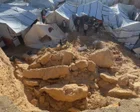
Four people, including three small children, died when torrential rain washed away a rocky sand bank that collapsed onto tents at a camp for displaced families south of Deir al-Balah in central Gaza. According to medics cited in the report, the rain fell heavily late on Sunday. A woman and two of her children, aged eight and six, were killed, and a fourth child, aged four, was also killed. Six others were injured. These are not abstract figures. They describe a mother and her children sleeping under canvas in the path of a slope that nobody had made safe.
The report notes that the collapse highlighted the danger facing hundreds of thousands of displaced Palestinians as the rainy winter season sets in. That phrase should shape how this tragedy is read. A sand embankment does not fall by accident on a site chosen for people with nowhere else to go. Families who have been displaced, sometimes more than once, end up pitched beside whatever land is available, and when that land is unstable, the consequences are predictable. The question is not only why the rain was heavy. It is why people were living in the path of the rain.
Witnesses, as the report's companion coverage describes, struggled to save people buried in what they called a horrifying landslide. Their accounts matter because they show that rescue depended on ordinary people digging with their hands, not on a system that could respond quickly. Any camp housing hundreds of thousands of people across a territory should have drainage, engineering assessment and early warning built into its planning before the first storm arrives.
What should happen next is clear enough. Those responsible for camp management and for relief coordination should inspect every site exposed to slope and runoff risk, relocate families out of danger where safer ground exists, and report publicly on what was done. Aid and shelter funding should be measured against winter readiness, not only against the emergency of the moment. Each winter that passes without these steps repeats a warning that has already been paid for in lives.
The deaths in Deir al-Balah are a reminder that displacement is itself a hazard. Protecting the families still living on unstable ground is not a side issue for the coming season. It is the test of whether anyone is taking responsibility for the people already at risk.